Search This Blog

Pookie Background

Tuesday, January 29, 2013

PEAP - Physician Education Awareness Program

Our state has an organization whose mission is to support families with children with special care needs. It is called Family Connections of SC.  While they have many programs, one that I particularly like is their Medical Education Programs:  Medical students and pediatric and family practice residents engage with families in home visits and connections outside the role of physician/patient to better understand family-centered care and the medical home.

Our local upstate chapter of Family Connections works with parents and 3rd year USC med students doing their residencies at Greenville Hospital System to provide PEAP - Physician Education Awareness Program.  I have hosted this twice at my house, and hope to do it many more times in the future! It's a wonderful opportunity to get young doctors in the homes of our "incompatible" children, and show them what they are REALLY like. I also get to explain how seeing a child in the hospital, or even for an office visit, does not give any medical professional an accurate picture of who the child really is and what they can accomplish.
This is from the Jan 2013 PEAP session. These 3 doctors hopefully have a more positive view of trisomy 18 in their careers.
This is Maddie, she as a 2q microdeletion and tag-teamed a PEAP session at my house in March 2012.
Our March 2012 session had a total of 6 med students. Here are four of them.
Here are the other two med students with Rebekah, my son - Jeremiah, and Family Connections' Michelle Johnson who coordinates this program in our area.

I polled my special needs families and trisomy families for input on what they would want to tell doctors and medical professionals about our children. This is what we came up with...

PEAP – Physicians Education Awareness Program
What Do You Do When You Have A Pediatric Patient With Multiple or Life-Threatening Disabilities?

1.  This is a child first and foremost 
  • Use People-First Language (I included some PFL handouts which was already part of what Family Connections gave the Med Students.)
    • People First Language (PFL) represents more respectful, accurate ways of communicating. People with disabilities are not their diagnoses or disabilities; they are people, first. PFL is not about "political correctness," it's about good manners and "the golden rule." 
    • http://www.disabilityisnatural.com/
  • Use the child’s name.
  • Speak of an unborn child as a person, not a thing.
  • Do not make assumptions about the capabilities of a child that you have only spent 5 minutes or less with. Ask to see pictures of the child in his/her home environment. Ask what milestones the child has reached. Ask how the child communicates. Children may be “nonverbal”, but still communicate effectively!
  • Even if managing care for a child that has 10% chance to survive, that child still DOES have a chance. They are not “incompatible”, care is not “futile”.
2.  Be Open To Interventions And Care Options
  • Parents (and doctors) can be realistic AND hopeful at the same time. Being realistic would include surgery recovery times, more aggressive and proactive care, etc.
  • Parents want choices – do not force or assume palliative care or hospice is always in order for a specific child.
  • Tell the WHOLE truth – not just the medical books truth. Give options and realistic expectations. If you don’t know what those are, don’t make assumptions. Be honest about it, or seek out documentation to support your views.
  • Intervention is not always wanted to prolong life. Sometimes intervention is necessary to improve the quality of life a child has – regardless of how long they will be here.
  • Give parents the information they need to make informed decisions. Don’t assert your personal opinion into the mix.
  • SUPPORT A PARENT’S DECISION, whether you agree with it or not. Don’t question why a child is full code.
3.  Each Situation Is Unique
  • Treat the child, not the syndrome. Each child is unique. Two children with the same syndrome will not have the same outcomes and issues. Don’t treat them with cookie-cutter care.
  • Treat the family, not the medical issue. Each family is unique. The care path that one family takes will not be the same as another family facing a similar situation. Adjust your care to the needs of each family and child.
  • Do not speak down to the parents, or treat them like they are idiots. For parents with an unborn child or infant, be compassionate. For parents with older children, they are probably far more aware of their child’s condition than you are.
4. Educate Yourself - Be Willing To Learn
  • What you learned in school does not necessarily reflect “reality”.
  • Listen to the parents – they will no doubt have insight into their child and maybe even the condition if it is something you have not had extensive experience with.
  • Network with families so you can grow beyond book and clinical knowledge to understand how families manage caring for a child with disabilities.
5. Be Compassionate
  • While you may see a child with a hopeless future, the parents see a child they love and cherish – no matter what. Don’t discount that love. A child cannot be replaced (“you can always have another baby”). One child is not more “valuable” than another (“save your time/effort/money for your other children…”).
6. Be Willing To Share
  • Families of children with disabilities need long term care and access to resources. Familiarize yourself with programs and support systems so you can pass that on.
  • Be willing to search and provide medical journal articles and supportive research papers that will help the family cope with their child’s specific issues.
  • Help connect families with similar disorders – peer support is critical!
7. Always Remember That You Are Not Seeing A Child At Their “Best”
  • There is a huge difference between seeing a child critically ill in the hospital, or sick in the doctor’s office, and seeing that same child in their home environment surrounded by comfort, familiarity, and love.
  • There are many children who react differently around “strangers” than they do at home.
8. What Parents Want You To Know
  • I love my child with fill-in-the-blank as much as I love my “normal” children.
  • My child loves me back.
  • My child communicates.
  • My child experiences joy, love, happiness.
  • My child with disabilities is special in many ways. They all have different needs.
  • Ask yourself, “What would I do if (insert name) were MY child?”

MiraLAX Users - Caveat Emptor!

Users of MiraLAX and other generic polyethylene glycol products need to be aware of potential harmful side effects from using this constipation medication!  Generics for MiraLAX include brands such as Clearlax, GlycoLax, Healthylax, Purelax, Dulcolax, and many other products containing polyethylene glycol 3350 (PEG) as an active ingredient.


Many people, especially special needs children, suffer with chronic constipation, reflux, and slow motility issues. Most doctor-prescribed "remedies" are prescription or over-the-counter drugs designed to mask the symptoms and address the problem with a man-made chemical solution.  In our own household, we are guilty of using these remedies time and time again. In fact, for Rebekah, we use a daily regiment of reflux and constipation medications. One popular drug, Nexium, has received a lot of heat for bone depletion issues and I mention this topic in this blog post about the dangers of Nexium and other PPI-type medications.

I was recently made aware of the following link which explains why MiraLAX (and any laxative using Polyethylene Glycol 3350 (PEG for short) as their active ingredient) is not good for you.
http://www.gutsense.org/gutsense/the-role-of-miralax-laxative-in-autism-dementia-alzheimer.html
It is comforting to know that the main ingredient of these laxatives is a chain of ethylene glycol molecules - commonly used in brake fluid and antifreeze. There is evidence showing extremely concerning potential side effects. I try not to be an alarmist, I know there are many websites out there that tell similar stories about many products we use (like corn syrups, artificial sweetners, etc). But it becomes increasingly alarming to think that all of our advancements in chemistry have just led us to create unnatural products that are harming us more than helping.

According to this particular miralax claim, there is supportive evidence that shows that polyethylene glycol (PEG) is associated with neurotoxicity, nephrotoxicity, urticaria, and esophageal perforations. As an osmotic laxative, it blocks absorption of nutrients in the small intestine and leads to dysbiosis (lack of intestinal bacteria). The FDA's Adverse Event Reporting System (AERS) has included reports of serious kidney, rinary, bowel, blood, skin, and neuropsychiatric symptoms.  What I appreciate most (despite this not being a "medical" paper) is the appropriate links to actual medical journal papers that support the claims.

I did my own quick search and here are just a few of the things I found that support the article:

  • WebMD says that common side effects of use are nausea, cramping, and gas (many of the symptoms we are trying to fix in the first place!), and that caution should be used if you have certain stomach & intestinal problems / obstructions (isn't constipation a form of obstruction and chronic constipation a stomach/intestinal issue?) or irritable bowel syndrome.
  • The New York Times posted an article last year that states that there is no warning about use of MiraLAX with children despite lack of studies. Even more troublesome is that pediatricians are prescribing MiraLAX for long-term use despite the warning labels not to use it more than 7 days (my generic brand says 14 days).
  • Even ehow.com states that long term use of MiraLAX can lead to diarrhea, dehydration, and mineral imbalance. (Given how many of our kids are on this as a long term regiment, how many of them are even having their blood checked for mineral imbalances?)

I don't know what to think anymore when you come across these websites that scare me into not using things. But it works! I have been thinking for a long time now how I can better help Rebekah and get her off of all of these unnatural medications for motility and bowel issues. We will be exploring blenderized diets and natural supplements, but I would be kidding myself if I said we are switching to all natural products and food. I can't put that kind of pressure on myself - I don't have the time or resources to do it all the "right" way. But I do know that educating myself helps me make better decisions and better choices for all of our family members, not just Rebekah.

So if you have something easy and affordable that works well, PLEASE share it with me! You may be able to help many other families besides mine.

Friday, January 11, 2013

Perfection


PERFECTION

by Michael Budd
(Written in honor of Rebekah Faith Budd- Full Trisomy 18 / Edwards Syndrome)

You play with toys, smile, laugh, and giggle;
You flap your arms, click your tongue, and wiggle.

You yell for joy, boredom, or disdain -
You want attention or to explain.

To a stranger it is unrecognizable noise;
To us it is cause to rejoice with the boys!

There is adoration in your eyes when you touch my face
And it shows me unconditional love and grace.

You roll, stand, and even, occasionally, we share a dance
Once this was only a dream and not even a chance.

You are designed as God wanted you to be -
Created in His image for all the world to see

That life is more about who you are
Than to what height you reach or what bar.

You are my amazing and precious little princess.
I cherish every moment we share and every success.

Some may treat you with rejection;
But we praise God for your perfection!


Wednesday, January 9, 2013

Everyone Poops

When you have four boys, rarely does a day (or a dinner) conversation pass without someone bringing up "poop". It inevitably is a part of our everyday conversation along with the other fun boy words like fart, belch, butt-head, smelly poopy-head, and the list goes on...

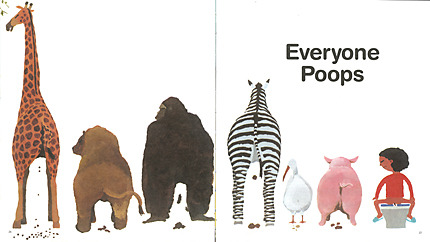
If it isn't the boys bringing it up, it's Rebekah's poopy diapers and poop explosions that seem to occupy my time. We just need to face it, POOP is a part of our everyday lives! If you don't believe me, then you obviously haven't read the book Everyone Poops by Taro Gomi.

Well, Tuesday was no different. Somehow, I expected it to be a grand day. Rebekah was getting her spica cast off! So on the way to the orthopedist's office, what happens? One last poop explosion up and out the back of the cast. That made for a lovely mess while they tried to cut the cast off.

To make things even better, I had orders to soak her in the tub until she was a prune to help her leg soreness. She wouldn't stay still in her bath chair and kept sliding down, so that wasn't working. I couldn't put her in a bath seat for babies because she had been casted at a 45 degree angle for 6 weeks and wanted nothing to do with sitting up fully. So I finally relented, put on a bathing suit, and sat in the tub with her. She was getting really irritable and started coughing. Well, with the coughing inevitably came... poop in the tub! I managed to hand her off to the nurse and started to drain/clean the tub so I could take a shower and clean myself off.

But there it was, at the bottom of the tub, as if mocking me... or perhaps just reminding me that I cannot escape my life doomed to poop at every turn. But living a sitcom kind-of-life, I didn't let a little poop bring me down. It can at least be washed off! So I did the only thing that I could do in a situation like this. I laughed and grabbed my phone and took a picture.  As the water continued to drain, another blob of poop formed a sad face, as if saddened, because it did not get the best of me!
"But there it was, at the bottom of the tub, as if mocking me...
or perhaps just reminding me that I cannot escape my life
doomed to poop at every turn."
"As the water continued to drain,
another blob of poop formed a sad face, as if saddened,
because it did not get the best of me!"
I promise that I did not "arrange" the poop in some sort of perverted manner. I just think God sometimes has a sense of humor.

Birdie, birdie in the sky,
Why'd you turdie in my eye?
I don't worry, I don't cry,
I'm just glad that cows don't fly!

And if you want to read more about poop, here is a link to Interesting Facts About Poop. My favorites from the list -
  • The average human poops 1/2 pound per day, while an elephant poops an average of 80 pounds of poop per day!
  • Poop can be classified into SEVEN groups. 
1. Separate hard lumps
2. Sausage-shaped but lumpy
3. Sausage-shaped with cracks
4. Sausage-shaped but smooth
5. Blobs with clear cut edges
6. Fluffy pieces, very mushy
7. Watery
Disclaimer: No poop was harmed in the creation of this blog post.

Wednesday, January 2, 2013

My Little Warrior Princess


The Warrior Princess Foundation - The Warrior Princess Foundation was founded by Michael and Chrissy Whitten after their precious daughter, Lilian Grace, earned her wings Thursday, August 5, 2010. She was born with T18, Edward’s Syndrome, on Sunday, April 25, 2010, and fought a daily battle for 103 days. Her parents realized the need and desire to help other families going through this similar journey due to the large costs and grueling daily battles this syndrome creates on a daily basis.  They wanted to create a way to help families, and so they began an annual fundraiser to help in that effort.

The foundation held it's second annual Trail Run fundraiser this past April 2012. They choose trisomy 18/13 children to recognize during the race. Rebekah was one of the these children honored both the first year of the run (2011), and the second year (2012).  We feel very blessed to receive an official Warrior Princess Medal which arrived for Christmas time.  Many thanks to the Whittens for honoring our trisomy children and for helping families in need! 
This is the medal that Rebekah received. The message reads,
"A small token/gift for your grace  & fighting spirit
through your true Trisomy Race. This medal is from the
2nd  Annual Warrior Princess Trail Run 10.3 miles, 10.3K &
Fun Run/Walk 1.03 miles races on April 25, 2012.
Love from Michael, Chrissy, Piper & Lilian (Angel)

Rebekah is totally thrilled at the honor of receiving an official Warrior Princess medal!


Navigate the slides to see more of Rebekah's funny faces. :-)

Tuesday, December 11, 2012

Broken Femur!

Rebekah has been doing great physically and we had her doing sit to stand with support and standing against a couch with minimal support. My dreams of her walking one day are getting closer and closer!  We've been coordinating with her therapists to maximize efforts to train her body towards this goal - weight shifting, stomping one foot at a time, and learning to use both sides independently. Things were looking good until...
Rebekah with a broken femur, in a half-spica cast (over one leg only and around the hips).


We never thought Rebekah had an issue with her bones! Yet here we are with a broken femur derived from her daily regiment of calf and hamstring stretches. And having a broken femur is not taken lightly. Her break, which occurred about 1/4 of the way from the top of the femur (at groin level), was considered a "trauma fracture". The immediate response is to look for child abuse, so they ordered a bone scan and a vitamin D test to determine if Rebekah has any signs of previous breaks. There were none, of course.  Even a forensic radiologist/pediatrician was called in to look at the "evidence".  The final report was "hypodense and gracile bones" and that it was very probable that this break did occur as reported.

Here is some information about osteoporosis and general statistics.  And here is a good reminder for anyone taking medications, especially our kids whose chromosomal abnormalities often exacerbate the potential side effects of those meds: Don't Take That Drug Without the Right Supplement.

I kept asking the doctors about a bone density test (BMD - Bone Mineral Denisty), but they did not do one because they said the numbers are not accurate for pediatric patients. Bone density tests are special x-rays that measure calcium and minerals.  The most commonly used BMD test is called a DEXA scan. The BMD is reported in terms of a T-score. A normal T-score is anything better than -1, osteopenia starts with a T-score of -1, and osteoporosis starts at -2.5. However, these numbers refer to adults, and there aren't really comparable numbers for toddlers.  According to a conversation with Dr. John C. Carey (Professor, Geneticist, Author of hundreds of medical papers, Medical Advisor for SOFT - Support Organization for Trisomy 18, 13, and Related Disorders, and a great friend/advocate to the trisomy community!), many trisomy 18 kids have been reported to have BMD  T-scores of -3.


So I kept digging for more information. Commonly listed characteristics or health problems of trisomy 18 children include reflux, weak muscle tone, heart defects, kidney defects, neurological issues, among many other things. Even if health is great, diet is great, and bones appear to be developing normally, children who are nonambulatory have weaker bones and lower tone than typical kids. Also, what the lists don't tell you is that there are additional risks associated with the treatment of these health issues. Many of the medications given to address these health issues can affect other parts of the body.  For example, throw in proton pump inhibitor meds for reflux, and guess what... you have a potential recipe for brittle bones!  (In 2011 & 2012, the FDA issues some warnings regarding PPIs and the potential for bone fractures and breaks.) I did not really connect the dots to any of this until we experienced a broken femur and started researching different reasons why trisomy kids' bones seem to break easily.


A few days after Rebekah was casted, I spoke with our nursing agency's nurse supervisor about Rebekah's care in the spica cast. She reminded me about changing positions every 2 hours. I remembered reading that in the pamphlet, and figured it was to prevent sores, issues with pressure points, etc. She said to make sure some of those positions are sitting up as best as we can do (which is very difficult since they casted her leg with two angles - one at the hip and one at the knee. Best we can do is about a 45 degree sitting angle.)  Anyway, she told me the positioning change is to PREVENT PNEUMONIA. I didn't realize that. She suggested CPT too. Well, got me thinking... so many of our little ones are prone to pneumonia. I wonder if it is partially because they are lying down too much and not getting moved into different positions? Plus, maybe every little one should get CPT as just general care early on?  

Anyway, I see trends and correlations between all these things! I hope passing along this info helps other families as they face different health issues and risks associated with trisomy 18.

Saturday, December 8, 2012

IMPORTANT WARNING ABOUT THE NEW DEVILBISS SUCTION CONTAINERS


IMPORTANT SHOUT-OUT TO ANYONE USING A DeVILBISS SUCTION PUMP:
Model 7305 with original
(discontinued) canister.

If you have an older gray DeVilbiss suction pump (7305 Homecare Suction Unit), or even if you recently switched to a newer pump, you probably have noticed that the canisters have changed and the filters are now BUILT INTO the top of the canister lid. This new design was made specifically for their new pump - Vacu-Aide Quiet Suction Unit but they made the design to also fit the gray machines and have stopped producing the old canisters with the external bacteria filter.
Vacu-Aide Quiet Suction with
new multi-model canister.


PROBLEM - THIS FILTER CANNOT GET WET! IF IT GETS WET, THE MACHINE OCCLUDES AND WILL NOT SUCK!!

Here is what happened to me -
My trached child, Rebekah, vomited in the middle of the night.  As all parents of trached kids probably fear, my worst nightmare was realized - it went INTO her trach and she aspirated.  I went to suction her, and the motor was working but the tubing had no suction. The canister appeared to be occluded. I had just replaced the canister with the new canister model that I received with my monthly supplies. I thought maybe I had installed it incorrectly. Let me tell you, I panicked! Thank God I kept an old canister and I was able to grab the old one, switch to the old filter, and I was able to get her airway cleared.

I wash my canisters religiously and even before first use. I have personally destroyed 3 of the new filters before even using a canister successfully because I washed the lid and did not remove the top piece with the filter. After all, there were no instructions, no warnings, how was I to know? I always wash my canisters daily, even before first use. My daughter doesn't need constant suctioning, so it wasn't until the next situation that I finally realized the problem - THE FILTER WAS DESTROYED AND OCCLUDED THE CANISTER.

So I am now trying to remember (after 3 1/2 years of using the old canister system) to remove the top part of the lid with the filter. Last time I did this by the sink where I was washing the rest of the canister unit, guess what happened? Yep, the piece with the filter fell into the sink too and got wet.

What a poor and DANGEROUS design!! AND WHY DID I NOT KNOW ABOUT THIS CHANGE?? There was no instruction, no warning, no information whatsoever on how to use the new style canister. My DME didn't know to order extra "new" filters for me or tell me not to wash the top connector to the lid. I did not know to call the company for instructions or look on the website.

So I called DeVilbiss Customer Service to complain and warn them that this topic has come up on several special needs boards. I explained that I need a filter ASAP.  I am told the part number to order more filters (7305D-635 for a pack of 12). Well, that's NICE, but what if I had not had an old canister/filter lying around? It's "nice" that I can order more filters, but that certainly didn't help the immediate situation. I did search for quite some time online for these filters. All of the online suppliers, even nextag and amazon, only have the OLD filters! So I don't even know where you are supposed to purchase these.  Bottom line, if I didn't have an old canister, I would've had to call 911 and my daughter might have ended up with aspiration pneumonia, or worse.

But back to the call... I also asked customer service why there was no warning or instructions. I was told the online FAQs for the Vacu-Aide Quiet Suction does say that a wet filter will occlude the canister. Sure enough:

Q7: When should the filter of the disposable canister be replaced?
A7:   1. If it becomes wet (it will immediately occlude when wet)
         2. Between patients
         3. When disposing of a used canister (the filter actually becomes a plug for the suction
canister when disposed of)
However, this isn't even my model! I have the 7305. It is no where to be found on my model's FAQs. In fact, the manual and the picture for my model still have the old canister and filter system (which is no longer being made). But the an improved 7305 model IS still being made. So why isn't this vital information updated and posted on the website? Once again, the info is with the new pump info. 

I did find an example of the old versus new canister set up: DeVilbiss Disposable Suction Container Kit Configuration.


So, if you have a DeVilbiss pump, please call them and tell them:

  1. The new design is unsafe, 
  2. The marketing regarding the new canister is terrible, 
  3. The instructions and warnings for use are missing,
  4. The filters are difficult to find, and 
  5. Every bottle should come with an extra filter "just in case" you accidentally drop your canister and get the filter wet, wash the whole lid, or knock the filter top into the sink (like me).

Here is the customer service number: 800-338-1988

Tuesday, October 23, 2012

A Photo Story...

No words really necessary...
IMG_9042
IMG_9043
IMG_9044
IMG_9046
IMG_9047
IMG_9048
IMG_9049

Sometimes being a brother is even better than being a superhero.  ~Marc Brown

Monday, September 24, 2012

The "Ah-Ha" Moment


I had an “ah-ha” moment this evening as I was putting the boys to bed. 

Rebekah has been in the hospital for the last 8 days, and I am exhausted physically and emotionally. The boys were bickering, name-calling, and complaining, and my usual screaming threats to tar and feather them were not working. When they continued to be nasty, for the first time in a long time, I stopped yelling back at them, grew silent and serious, and began to tell them about one of our biggest blessings of having Rebekah - appreciation for life. We almost lost Rebekah to a bowel obstruction last summer, and when this hospital trip confirmed another bowel obstruction, we all had some fear and despair of weeks in the hospital (or worse). So I explained to those precious boys that we have been gifted through Rebekah. Even my 5 year old appreciates seeing his little sister and misses her when she's not there. He understands the threat with each hospital admission.

So my conversation with those sweet boys went something like this...
Because we're a family, we will have disagreements and arguments with each other. But we need to know that, just like Rebekah, none of us are promised another day. There could be a terrible accident, and you could wake up to find out that your brother is dead. Do you really want the last memory of your brother to be that you called him a loser? Or an idiot? Don't you think that it would fill you with guilt and sadness when you remember your last conversation?

Ephesians 4:26-27 says: And "don't sin by letting anger control you." Don't let the sun go down while you are still angry, for anger gives a foothold to the devil.

So I want you all to lie here silently and say a prayer for forgiveness and a prayer for patience and love for your brother.

I left the room for a few minutes and came back to total silence. I don't think my house has EVER been that quiet.  Then I tucked them in and prayed for our whole family to have the kind of grace and forgiveness for one another that we have received ourselves.

I became really sad, because I had done something in anger recently while under the stress of Rebekah being in the hospital. I could blame it on my exhaustion and situation, but the truth is, I have to own up to my own mistakes.  And I can do that because I know being a Christian doesn't mean I am perfect... it means I can admit and recognize my imperfections.

So I called up a friend who I had hurt in a public post on Facebook, and apologized. She had even left our support group that had been her lifeline when her son was younger. And that was never my intention or desire! I would never want to take away someone's support network, or make them feel like they had to make a choice between friends.  The individual posts that led my "meltdown" aren't important.  The truth is, I acted in anger, and hurt someone as a result. But even worse, I influenced others to think ill of this mom. And, like me, she is a mom that just wants support and to advocate for her child.

So I told her sincerely, from my heart, that I am truly sorry - not just for making it a public post, but for making her out to be a terrible person. I never thought about how my post would influence others nor trigger some to send her hurtful messages as a result. And that was never my intention!! And I would never want to take away someone's support network.

I apologize to my support network also. I did not mean to make my personal issues public. I never intended to drag you down with me.  I pray that you will show grace to both of us.

Although it is very late now and I am still riddled with exhaustion and the threat of a 6 am alarm clock, I think I will sleep the next 4 hours better than I have all week. And I go to sleep praying for each of us to have many of these ah-ha moments in our lives... for it is these trials that mold us, hopefully, into better people.

Monday, July 30, 2012

Our Trisomy Community Has a Voice

Our Trisomy Community Has a Voice...
Children with Trisomy 13 and 18 and Their Families are Happy!


On 7/23/2012, a precedent-setting study was published in PEDIATRICS – the official journal of the American Academy of Pediatrics. The study consists of 503 invitations sent to families using social networks as support systems in the care and management of their trisomy 13 or 18 child.  An amazing 332 questionnaires were returned (87% response rate) representing 272 trisomy 13 or 18 children. I am proud to be one of those families!  

Why is this precedent-setting? 
  • First of all, there are NO OTHER studies of trisomy 13/18 children represented by such a large sample group! 
  • Second of all, this study will challenge the medical community to rethink how they manage families facing a diagnosis like trisomy 13 or 18.  

My personal hope is that the medical community will also start partnering with the real experts on trisomy – the PARENTS – to help make decisions in the care and management of future trisomy children. We are bringing together families worldwide through social networking, and working together to create resources that will give families the information they need to make informed decisions about their trisomy children. Some of this information is based off of the small number of medical studies (with small sample sizes) that have already been published on trisomy 18 and 13 children. But the majority of it comes from the actual experiences of hundreds of parents and family members involved in the direct care of a trisomy child. Some of this information is already being captured (and has been for years) through a project called TRIS (Tracking Rare Incidence Syndromes) and through the annual conferences and medical information collected through SOFT – Support Organization for Trisomy 18, 13, and Related Conditions. There are also several social networking groups on facebook and nonprofit trisomy organizations working together to create a Parent Experiential Database to summarize much of the knowledge learned and shared between trisomy parents dealing with complex health issues. The beginnings of this parent database will be captured by the end on 2012 on www.hopefortrisomy.org.  We hope this will also inspire the medical community to do more studies on our children, and to change the view that trisomy 18 and 13 children are incompatible with life and not worth the time or effort to give compassionate and potentially life-saving care.

As for the Pediatrics-published study, one of the most well-published academic neonatologists in the world (and a true humanitarian) posted about the study on his neonatal research blog. He offers EXCELLENT ADVICE (and a little criticism) to his colleagues. 

And here is just a brief look at how this new study has affected the news...

The Most News Seen on Trisomy 18 or 13 in Such a Short Time!
These are just a few of the pages and pages of references to the Pediatrics-published study...  
  • The Canadian Press – Toronto (7/23/12): Parents of babies born with disabling anomalies report they enrich families
    “This study should have us stop and think about what decisions, for which children, have been made on the basis of misinformation,” says Francoise Baylis, a professor of bioethics and philosophy at Dalhousie University in Halifax. “The negative narrative needs to change. Parents’ experiential knowledge matters and should be available to expectant parents and new parents.”   
  • Daily RX(7/22/12): Trisomy 13 and 18 children and their parents lead rewarding lives
  • Deseret News(7/27/12): Parenting Severely Disabled Kids Can Be a Great Source of Happiness 
    "Regardless of the length of their lives, children with trisomy 13 or trisomy 18 — a chromosomal abnormality that can cause shortened lifespans and severe disabilities — not only led happy lives, but enriched the lives of their families, according to a new study published in the journal Pediatrics July 23."
  • EurekAlert! (7/23/12): Children with trisomy 13 and 18 and their families are happy – Quality of life perceived by parents is better than that predicted by physicians
  • Europe Med (7/25/12): Children With Trisomy 13 and 18 Are Happy Despite Poluar Beliefs
  • Fox News (7/23/12): Parents, docs may clash on quality of kids’ lives
  • HuffPost Living CanadaT13,T18 Babies Born With Congenital Anomalies Reportedly Enrich Families
    "A new Canadian study drawing on the experiences of parents paints a dramatically different picture than that in medical literature of the short lives of infants born with the congenital anomalies Trisomy 13 and Trisomy 18.Medical textbooks are grim and bleak about babies born with genetic codes considered "incompatible with life." But the study says parents who have these children speak of the joy found in what is almost inevitably a short lifespan. These children, they say, can enrich a family rather than destroy it."
  • JAAPA (Journal of the American Academy of Physician Assistants) and MPR (Monthly Prescribing Reference)(7/23/12): Study Examines Effect of Trisomy 13, 18 on Families, Providers
  • Medical News Today (7/24/12): Children Eith Trisomy 13 and a8 Are Happy Despite Poluar Beliefs
  • Medline Plus (7/23/12): Parents of Severely Disabled Kids Say They Enrich Their Lives 
  • Montreal Gazette (7/25/12): Parents of kids battling rare disorder Trisomy 13 fight back – Doctors take approach to condition, they say
  • Neonatal Research blog - Dr. Keith J Barrington (neonatologist and clinical researcher and chief  of service at Sainte Justine University Health Center in Montréal.): “Our children are not a diagnosis”: the family experience of trisomy 13 and 18  Dr. Barrington includes a list of guidelines that neonatologists should follow. "This study points out the uniqueness of each of these children and the heterogeneity of condition and survival. They emphasize that we cannot be definite about the duration of survival or the capacities of an individual. They conclude: Parents who engage with parental support groups may discover an alternative, positive, description about children with T13-18. I conclude; we need to rethink how we present diagnoses of serious conditions to parents." Science Daily (7/23/12): Children With Trisomy 13 and 18 and Their Families Appear Happy
  • Seattle Children's Hospital (7/24/12): Social Networks Serve as Source for Parents  "Mildred Bay initially found some solace and information via social networks.  A pediatrician by trade, Dr. Bay was a resident at Seattle Children’s and now works at Peninsula Children’s Clinic.  Lucy, 3 and one-half months old, has trisomy 18.  Dr. Bay said hearing that diagnosis was a complete shock. ...  “I would look at various blogs and websites, and learn about what other families’ experiences were like.”  Many families have very intense but ultimately very positive experiences with their children despite the diagnosis, she found.  “As a pediatrician, and having worked at Seattle Children’s, I knew kids with complex medical issues.  The road is hard, but not unmanageable if you have the right support.”"  
  • Suite 101 – Pregnancy & Childbirth (7/25/12): Raising a Child with a Disability – Parent’s vs Physician’s View 
  • US News & World Report (7/23/12): Parents of Severely Disabled Kids Say They Enrich Their Lives – Families dealing with trisomy 13-18 face grim predictions, turn to online support, study found  "When Vanessa Hernandez's sixth child was born, she knew right away her daughter was different.Hernandez's pediatrician wept as she told her the diagnosis. The baby had trisomy 13, a devastating chromosomal abnormality. Most children die before their first birthday and have serious mental and physical disabilities, including heart and breathing problems....according to the study in the August issue of Pediatrics. Many parents -- 87 percent -- were told their child's condition was "incompatible with life," 57 percent were told their child would live a life of suffering, 50 percent were told their child would be a "vegetable" and 23 percent were told their child would "ruin their family." The medical community, including the American Academy of Pediatrics Neonatal Resuscitation Program textbook, recommends against resuscitation for trisomy 13 and 18." 
  • Washington Post (7/23/12): Varying views on Trisomies 13 and 18

More on Barb Farlow's Story: 
Barb Farlow is one of the co-authors of this amazing study.  I am extremely privileged to know Barb. She is such a tremendous resource to the trisomy 13 & 18 communities. Her story about her T13 daughter is worth the read! She is an amazing woman and mother, and an incredible advocate for our children.